Today's date is: October 5, 2026
Genesis Chapter 27
Isaac, Rebekah, Jacob and Esau
The Stolen Blessing
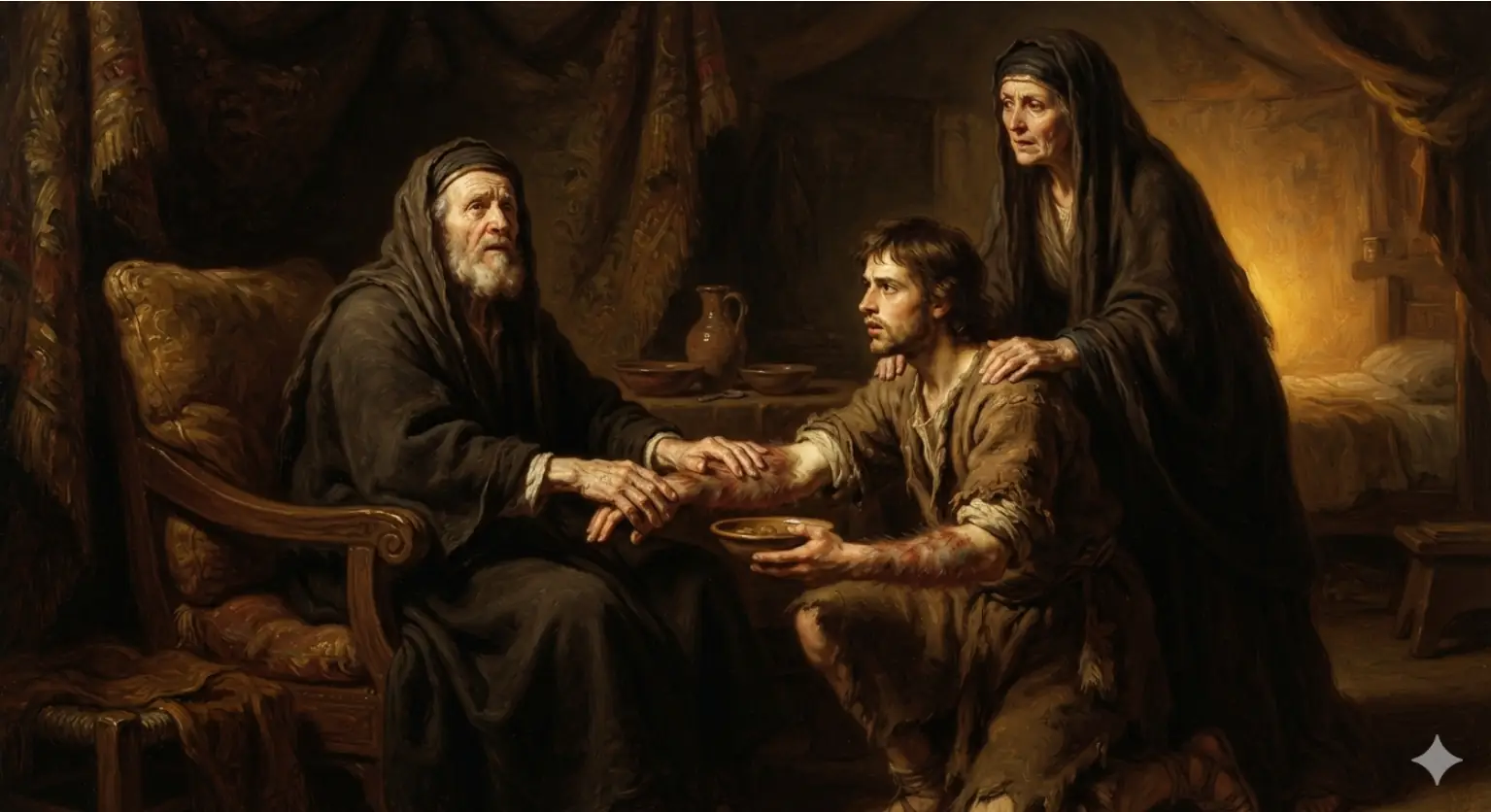
Genesis Chapter 27 details the deception of the aging and blind patriarch Isaac by his wife Rebekah and younger son Jacob, resulting in Jacob stealing the covenantal firstborn blessing intended for his older twin brother, Esau. The chapter highlights the severe consequences of family favoritism, human manipulation, and the subsequent fracture of the household.
The Character Dynamics and Motifs
Genesis Chapter 27 exposes a deeply fractured family where every member operates in isolation and deceit, moving entirely away from open communication.
- Isaac:
Driven by physical appetite and human favoritism, he attempts to bless Esau in secret, ignoring the divine oracle given to Rebekah that the older would serve the younger.
- Rebekah:
Motivated by favoritism and a desire to fulfill God's prophecy through human manipulation, she orchestrates a high-risk scheme, willingly taking any curse upon herself.
- Jacob:
Though initially hesitant out of fear of getting caught rather than moral objection, he complies and explicitly invokes God's name to execute a bold lie.
- Esau:
Displays a volatile blend of short-sightedness and intense grief, forgetting that he had already legally sold his birthright to Jacob in Chapter 25.
The Themes of Sight, Scent, and Touch
The narrative heavily leans on sensory deception to highlight the subversion of physical reality by spiritual destiny.
- Blindness:
Isaac’s physical blindness mirrors his spiritual blindness regarding his sons' true characters and God's sovereign choice.
- The Voice vs. The Hands:
Isaac's famous discernment—"The voice is Jacob’s voice, but the hands are the hands of Esau"—shows a split perception where physical manipulation overrules his correct intuition.
- The Smell of the Field:
The outdoor scent of Esau's clothing acts as the final anchor of deception, triggering Isaac's emotional connection to his favorite son and prompting the release of the blessing.
Structure: The Anatomy of a Deception
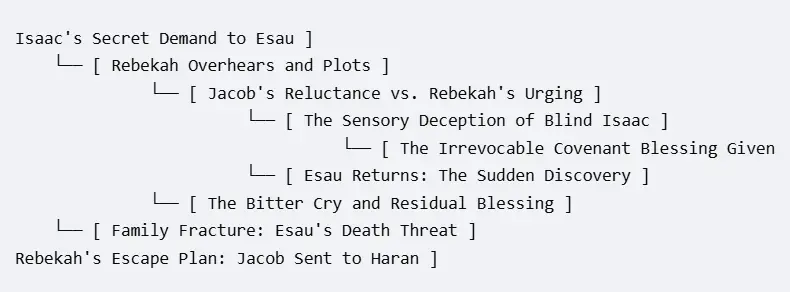
The Legal and Irrevocable Nature of the Blessing
In the Ancient Near East, a patriarchal deathbed blessing carried binding legal weight, acting as an oral will and testament.
- Divine Agency:
Once spoken, the blessing was treated as a prophetic force set in motion by God.This explains why Isaac "trembled violently" when he realized the trick; he knew he could not recall the words, as God had sealed them.
- The Consequences:
Jacob receives the primary covenantal line—agricultural abundance, mastery over his brothers, and national prominence.Esau's residual blessing locks him into a harsher, nomadic existence in the rugged terrain of Edom (Mount Seir).
Poetic Justice and Long-Term Fallout
While Jacob successfully intercepts the blessing, the narrative demonstrates that deception breeds severe consequences for everyone involved.
- Rebekah never sees her favorite son Jacob again; he remains in exile for over 20 years, and she passes away before his return.
- Jacob is immediately forced to flee for his life, losing the comfort of his home. Later, his uncle Laban tricks him using the cover of darkness (another sensory blindness) to substitute Leah for Rachel, matching Jacob's deception of his blind father.
- The Family Unit is completely shattered, mirroring the macro-tensions that later define the historical animosity between the nations of Israel (Jacob) and Edom (Esau).
How later New Testament writers (like Paul in Romans or the author of Hebrews) theologically interpret Esau’s lost blessing.
New Testament writers pick up the narrative of Esau’s lost blessing to illustrate profound theological truths about divine election, spiritual short-sightedness, and the finality of rejecting God's grace
Rather than viewing the events of Genesis 27 as a mere family drama, the New Testament interprets Esau and Jacob as archetypes of two completely different responses to God.
1. Paul in Romans 9: Sovereign Election and Mercy
Apostle Paul uses the story of Jacob and Esau to anchor his defense of God's absolute sovereignty in election.
He argues that God’s purposes do not depend on human effort or lineage, but entirely on His divine will.
- Before Birth:
Paul points out that God chose Jacob over Esau before the twins were even born or had done anything good or bad (Romans 9:11).This completely detaches God’s covenantal choice from human merit or Jacob's later trickery.
- "Esau I Hated":
Paul quotes Malachi 1:2–3, writing, "Jacob I loved, but Esau I hated" (Romans 9:13).In ancient Near Eastern covenantal language, "love" and "hate" are idioms for choosing and rejecting for a specific covenant purpose.Paul is emphasizing that Esau was bypassed as the carrier of the Messianic line.
- The Theological Focus:
PPaul shifts the perspective away from Jacob’s deception.In his view, the lost blessing shows that human scheming cannot force God's hand, nor can human flesh (Esau being the firstborn) override divine destiny.
2. The Author of Hebrews: Spiritual Profanity and Apostasy
The author of Hebrews uses Esau as a sobering warning for believers tempted to abandon their spiritual inheritance under pressure.
He treats Esau’s lost blessing as the ultimate example of trading eternal value for immediate, physical gratification.
- The "Godless" Archetype:
Hebrews 12:16 labels Esau as "profane" or "godless" because he sold his inheritance for a single meal.The text treats his attitude toward the birthright (Gen 25) and the blessing (Gen 27) as interconnected symptoms of a worldly mind.
- The Place of No Repentance:
Hebrews 12:17 provides a terrifying commentary on the aftermath of Genesis 27:"For you know that afterward, when he desired to inherit the blessing, he was rejected, for he found no chance to repent, though he sought it with tears."
- The Theological Focus:
Hebrews clarifies that Esau’s tears were not tears of genuine repentance over his godless attitude; they were tears of regret over the lost consequences (the physical inheritance).The author uses Esau to warn early Christians that there is a point of spiritual hardness where a bypassed opportunity for God's grace cannot be reclaimed.
| NT Author | Primary Passage | Esau Represents | Core Theological Lesson |
|---|---|---|---|
| Paul | Romans 9:10–13 | The bypassed line of flesh; human effort. | God's sovereignty and mercy are independent of birth order, human merit, or works. |
| Author of Hebrews | Hebrews 12:15–17 | The apostate; the worldly person who trades future glory for instant comfort. | Guard your spiritual inheritance fiercely; rejecting God's grace brings irreversible consequences. |