Today's date is: October 5, 2026
Genesis Chapter 30
Jacob and Rachel
The Dramatic Expansion of Jacob's Family
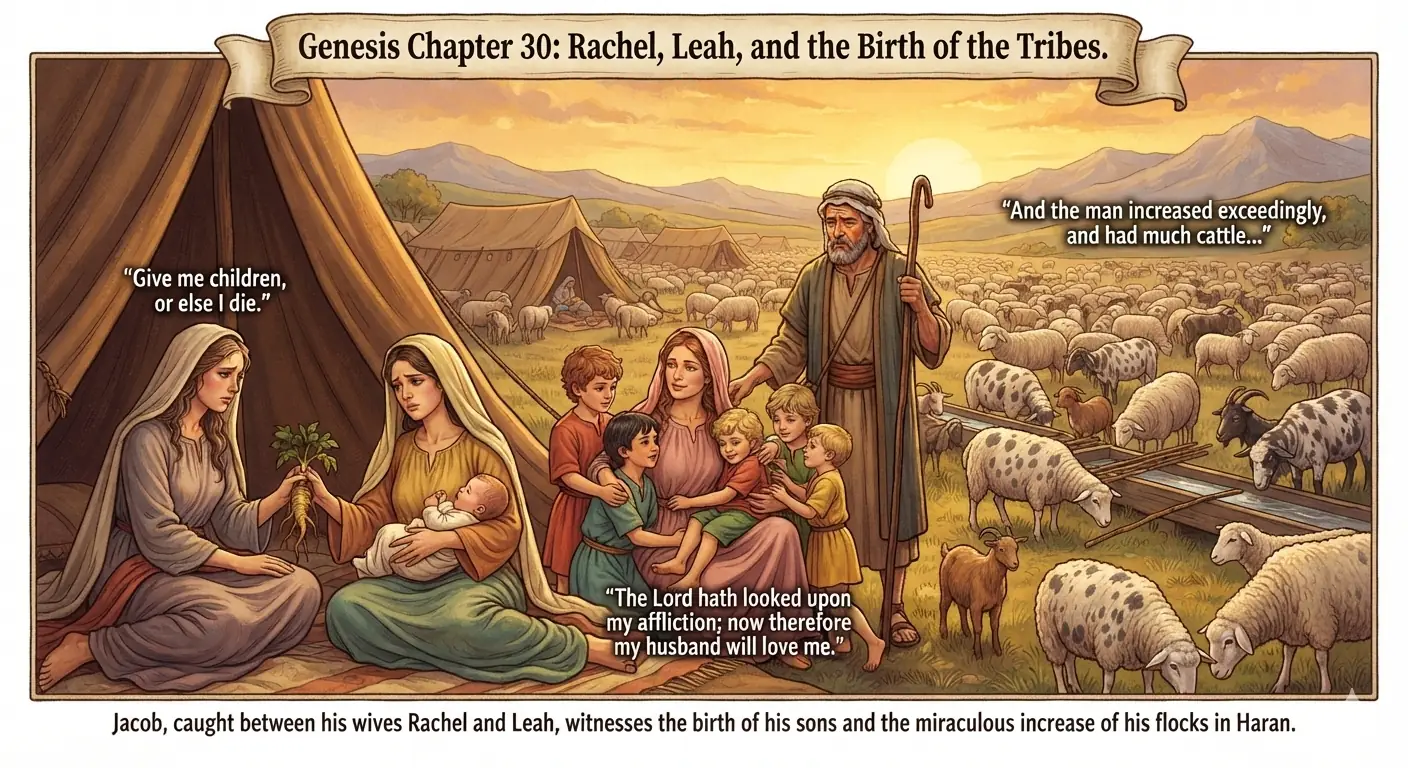
Genesis Chapter 30 details the dramatic expansion of Jacob's family through sibling rivalry and the miraculous growth of his wealth while working for his father-in-law, Laban.
The Birth of Jacob's Children
Genesis Chapter 30 details the intense family rivalry between Jacob's wives over childbearing and Jacob's strategic agreement with Laban that leads to immense wealth.
- Rivalry and Surrogates:
Rachel, initially barren and desperate ("Give me children, or else I die"), gives her maid Bilhah to Jacob, who bears Dan and Naphtali.Following suit, Leah gives her maid Zilpah to Jacob, who bears Gad and Asher.
- The Mandrakes:
Leah's son Reuben finds mandrakes (plants associated with fertility) in the field.Rachel trades an evening with Jacob for these mandrakes.Leah subsequently bears Issachar, Zebulun, and a daughter, Dinah.
- Rachel's Son:
God finally remembers Rachel, opening her womb to give birth to Joseph.
Wages and Prosperity
- The Agreement:
Jacob asks to leave Laban's service, but Laban asks him to stay and name his wages.Jacob requests all the speckled, spotted, and black livestock as his pay.
- Laban’s Deception:
Laban attempts to cheat Jacob by removing all such colored animals beforehand and moving them a three-day journey away.
- Jacob’s Strategy:
Jacob uses selective breeding methods involving peeled sticks at the watering troughs during the breeding of stronger livestock, resulting in robust, multiplying flocks that make Jacob exceedingly prosperous.
🏛️ Theological & Literary Structure
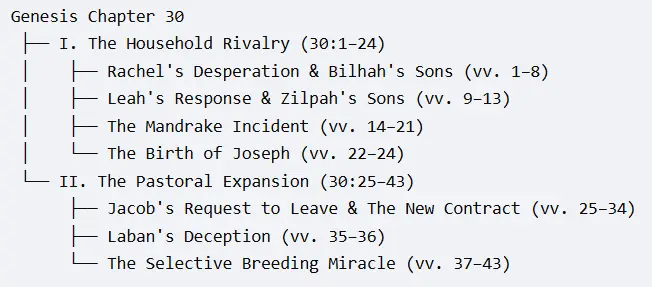
Genesis Chapter 30 serves as a major turning point in the patriarchal narrative, detailing the birth of Jacob's children (who would form the twelve tribes of Israel) and Jacob’s strategic accumulation of wealth despite the deceptions of his father-in-law, Laban.
The chapter structurally splits into two core movements: the dysfunctional "baby wars" inside Jacob's household (verses 1–24) and the miraculous breeding program in the pastures of Haran (verses 25–43).
👥 Part 1: The Rivalry and the Birth of the Tribes (vv. 1–24)
This section highlights the intense, painful sibling rivalry between Rachel and Leah.
Because Laban's trickery forced polygamy onto the family, children become weaponized as symbols of divine favor, status, and affection.
- Rachel’s Desperation (vv. 1–8):
Barren and consumed by jealousy, Rachel demands of Jacob, "Give me children, or else I die".Jacob angrily responds that only God controls the womb.Rachel resorts to surrogacy—a common Near Eastern legal custom—giving her maid Bilhah to Jacob.Bilhah bears Dan ("God has judged me") and Naphtali ("My wrestling").
- Leah’s Counter-Strategy (vv. 9–13):
When Leah sees her own childbearing pause, she counters by offering her maid Zilpah to Jacob.Zilpah bears Gad ("Good fortune") and Asher ("Happy").
- The Mandrake Deal (vv. 14–21):
Leah's son Reuben finds mandrakes—plants ancient cultures associated with aphrodisiacs and fertility.Desperate Rachel "rents" Jacob out to Leah for the night in exchange for the mandrakes.Paradoxically, the mandrakes do not help Rachel; instead, God answers Leah’s prayer.She conceives Issachar, Zebulun, and Jacob's only named daughter, Dinah.
- The Birth of Joseph (vv. 22–24):
Finally, text notes that "God remembered Rachel".She gives birth to Joseph ("May he add"), signaling an end to her public reproach.
🐏 Part 2: The Breeding Program and Laban's Deception (vv. 25–43)
After Joseph's birth, Jacob completes his 14 years of forced service and asks to return to Canaan. Recognizing that God has enriched him solely due to Jacob's presence, Laban begs him to name his wages.
| Aspect | The Livestock Agreement & The Outcome | |
|---|---|---|
| Jacob's Proposed Wages | Jacob asks only for the speckled, spotted, and black sheep and goats. These are genetically rare recessive traits, leaving Laban with the vast majority of the white/solid flocks. | |
| Laban's Deception | Laban immediately agrees, but stealthily removes all existing colored and spotted animals that night, hiding them a three-day journey away so Jacob's flocks have no parent stock to breed colored offspring. | |
| Jacob's Tactic | Jacob peels white streaks into fresh sticks of poplar, almond, and plane trees, placing them in the watering troughs where the animals mate. He also selectively breeds only the strongest of the flocks. | |
| The Result | The visual stimulus (or modern pharmacological elements in the bark) combined with supernatural favor works. The strongest animals consistently produce speckled offspring. Jacob grows exceedingly wealthy. |
🔍 Key Themes and Analysis
- Sovereignty Over Human Cunning
- Science vs. Providence in the Breeding Program
- The Consequences of Polygamy
A primary takeaway of Chapter 30 is that human manipulation cannot bypass or derail divine plans.
Rachel tries to force fertility with surrogacy and folk magic (mandrakes); Laban tries to cheat Jacob out of his fair wages.
Ultimately, it is God who opens the womb and God who multiplies the flocks.
For centuries, commentators viewed Jacob's striped sticks as an outdated superstition or folk magic.
However, modern agricultural and botanical research, documented by institutions like Answers in Genesis, notes that the bark of poplar and almond trees contains natural compounds like salicin and tannins.
These act as uterine health tonics, reducing disease and increasing ovular fecundity.
Combined with Jacob's skilled veterinary practice of selective breeding, God used natural means amplified by supernatural intervention to deliver justice against Laban.
The narrative serves as a stark warning about deviating from God's intended marriage design.
The emotional trauma, human commodification, and toxic home environment experienced by Leah and Rachel show how polygamy fragments families and builds generational bitterness.