Today's date is: October 5, 2026
Genesis Chapter 31
Jacob, Leah, Rachel, Laban and his sons
Jacob returns to Canaan
Genesis Chapter 30 details the dramatic expansion of Jacob's family through sibling rivalry and the miraculous growth of his wealth while working for his father-in-law, Laban.
💼 Executive Summary
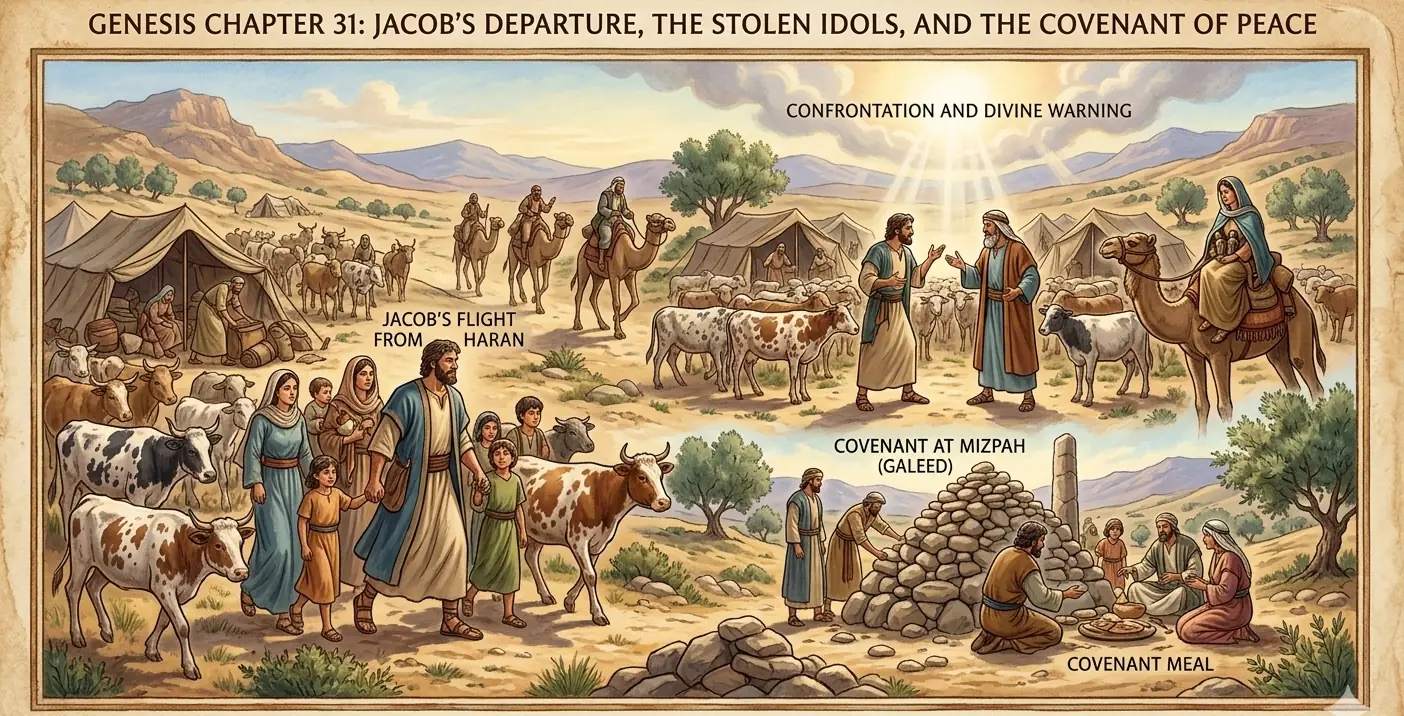
Genesis Chapter 31 marks a pivotal turning point in the Patriarchal narrative, chronicling Jacob’s covert flight from Haran back to the Promised Land of Canaan after twenty years of service under his manipulative father-in-law, Laban.
The chapter serves as a theological bridge highlighting the transition from human scheming to divine reliance.
It addresses core themes of systemic exploitation, covenant faithfulness, familial deceit, and the definitive geographic and cultural separation between Abraham's lineage and the Mesopotamian idolaters.
1. Structural Breakdown & Narrative Outline

The chapter naturally divides into five movements tracking the escalation, confrontation, and ultimate resolution of the conflict:
- The Divine Mandate and Marital Alignment (vv. 1–16):
Triggered by the open hostility and envy of Laban’s sons, God commands Jacob to return to Canaan.Jacob summons Rachel and Leah to the open field—ensuring privacy from Laban's household—where his wives validate their father's exploitation and fully consent to flee.
- The Secret Flight and Rachel’s Theft (vv. 17–21):
Capitalizing on Laban’s absence during the sheep-shearing season, Jacob moves his enormous household across the Euphrates River toward the hill country of Gilead.Rachel secretly steals her father's teraphim (household idols).
- The Pursuit and Divine Interception (vv. 22–24):
Laban learns of the flight three days late and pursues Jacob for seven days.Before Laban can strike, God intervenes in a dream, strictly warning Laban not to say anything to Jacob "either good or bad" (a Hebrew idiom meaning he must not threaten or attempt to alter Jacob's course).
- The Confrontation and Search for Idols (vv. 25–42):
Laban overtakes Jacob and accuses him of stealing his daughters away like "captives of the sword" and robbing him of his gods.Unaware of Rachel's theft, Jacob pronounces a rash death curse upon whoever stole them. Rachel cleverly evades discovery by sitting on the idols inside a camel saddle, claiming she cannot rise due to her menstrual cycle.Jacob then unleashes a scathing, decades-in-the-making rebuke detailing Laban's unfair wages and his own grueling, faithful labor.
- The Treaty of Mizpah and Separation (vv. 43–55):
Acknowledging his powerlessness against Jacob's God, Laban proposes a non-aggression pact.They erect a stone pillar and a heap of rocks (Galeed or Mizpah) to serve as a territorial boundary marker.Following a shared sacrificial meal and a final blessing, they part ways permanently.
💡2. Key Theological Themes & Exegesis
The Sovereignty of God Over Human Exploitation
A primary theological theme is that God governs human provision and restrains violence.
Laban is depicted as an arch-exploiter who changed Jacob's wages ten times (v. 7), yet God consistently neutralized Laban's greed by causing the flocks to multiply in Jacob’s favor regardless of the parameters set.
This demonstrates that the fulfillment of the Abrahamic Covenant relies completely on divine faithfulness rather than human integrity or favorable circumstances.
The Concept of "The Fear of Isaac"
In verse 42 and 53, Jacob refers to Yahweh using a unique title: "the Fear of Isaac" (Pahad Yizhaq).
This rare epithet captures the deep, reverent awe that characterized Isaac’s relationship with God, distinguishing Jacob's transcendent deity from Laban’s tangible, easily stolen household idols.
| The Teraphim (Laban) | The Fear of Isaac (Jacob) |
|---|---|
| • Small, material objects | • Sovereign, uncontainable |
| • Can be stolen / hidden | • Rules over human dreams |
| • Requires protection | • Protects and provides |
The Irony of the Teraphim
Rachel's theft of the teraphim is laden with narrative irony.
In the ancient Near East (documented heavily in the Nuzi Tablets), ownership of household gods was often linked to family inheritance rights and legal leadership.
By sitting on them and associating them with menstrual uncleanness, the narrative delivers a cutting polemic against Mesopotamian idolatry: these so-called deities are powerless, easily hidden by a woman, and literally rendered ritually unclean.
3. Character Analysis
- Jacob (The Transforming Deceiver):
Jacob is caught between old habits and emerging faith.He obeys God’s call to return home but executes it in fear-driven secrecy rather than bold faith.However, his defense in verses 36–42 reveals his development into a man of profound integrity regarding his work, highlighting twenty years of enduring extreme weather and taking personal losses to protect flocks that weren't his own.
- Laban (The Earthbound Materialist):
Driven entirely by covetousness, Laban views his daughters, grandchildren, and flocks as his exclusive property (v. 43).He tracks Jacob down with hostile intent, and only bows to peace when a terrifying divine dream leaves him no choice.
- Rachel & Leah (The Disinherited Wives):
For the first time, the rival sisters are united in purpose.They point out that Laban treated them like "foreigners" by spending their bride-prices (v. 15), viewing Jacob's accumulated wealth not as a theft from their father, but as a divine restoration of their stolen inheritance.
4. Cultural and Historical Context
The legal and social dynamics of Genesis 31 mirror documented Bronze Age legal customs of the Ancient Near East:
- The Shearing Season:
Sheep shearing (v. 19) was a festive, labor-intensive period that required all available men to gather at central stations far from residential camps.This explains how Jacob found a three-day window to mobilize hundreds of animals and family members undetected.
- The Treaty of Mizpah (vv. 44–53):
This follows standard ancient Near Eastern boundary treaty formats.The stone heap acts as a silent witness (Ed), and the invoking of gods (Laban invokes the God of Abraham and the god of Nahor) served to curse whichever party crossed the line with hostile intent.Paradoxically, the famous "Mizpah Blessing"—"The Lord watch between you and me when we are absent one from another" (v. 49)—was not a tender farewell, but a stern warning born of mutual distrust, asking God to police each man's behavior when they could no longer watch each other. - The Treaty of Mizpah (vv. 44–53):